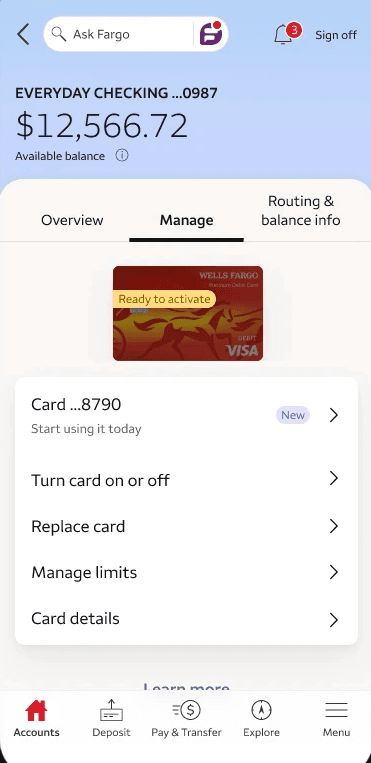
I led content design for a digital debit card display feature that gives customers instant access to their card credentials while waiting for a physical card to arrive. The work eliminated the need for rush shipping, addressed a top JD Power card replacement pain point, and drove an estimated $800K in annual cost savings — while establishing a content framework designed to scale toward a permanent digital card experience.
Customers with a new or replacement debit card had no way to access their full card information until the physical card arrived in the mail. The only workaround was to request rush shipping.
Without access to card credentials, customers couldn't make purchases, set up subscriptions, or complete payments during the delivery window. This left them waiting days for basic card functionality.
This affected both new cardholders (3.8M annually) and existing customers replacing a lost or stolen card (13M annually). Card replacement was already a high-stress moment, and the wait compounded it.
The gap in card access drove high rush shipping volume, increased operational costs, and was consistently flagged as a top customer pain point in JD Power and Voice of Customer data.
The solution concept was already defined. Content design work focused on execution by shaping the language, information hierarchy, and user guidance across the experience. I evaluated the experience to understand how to communicate a card that's partially temporary and partially permanent, where users would need guidance around the transition, and what edge cases could create confusion after the physical card activated.
The temporary CVV and expiration created a mental model challenge — users needed to understand that part of their card info would change, while the card number would not. Subscription services set up with temporary credentials would break after activation, a scenario that needed proactive guidance.
And overly qualifying the card as "virtual" or "temporary" risked making the feature feel less trustworthy — and would create rework when the experience becomes permanent.
This shaped a clear job to be done: when someone is waiting for a debit card to arrive, they want immediate access to their card information so they can make purchases and payments without waiting for the physical card.
I owned end-to-end UX content for the digital debit card display across desktop, mobile, and browser. That meant content strategy for communicating temporary credentials versus permanent card number, writing and iterating all user-facing copy, and designing guidance around the subscription edge case and the temporary-to-permanent transition.
I also influenced the language strategy for future-state scalability, partnered with product and design to shape the end-to-end experience, worked with engineering on how credentials surfaced and when the display disabled, and aligned with legal, compliance, and the credit card team for consistency.
The content strategy treated the digital card as the user's real card — not a secondary or lesser version. "Temporary" was scoped to specific credentials, not the overall experience. And the language was designed with future-state scalability in mind, minimizing copy that would need to change when the display becomes permanent.
The experience was shaped by four key content decisions.
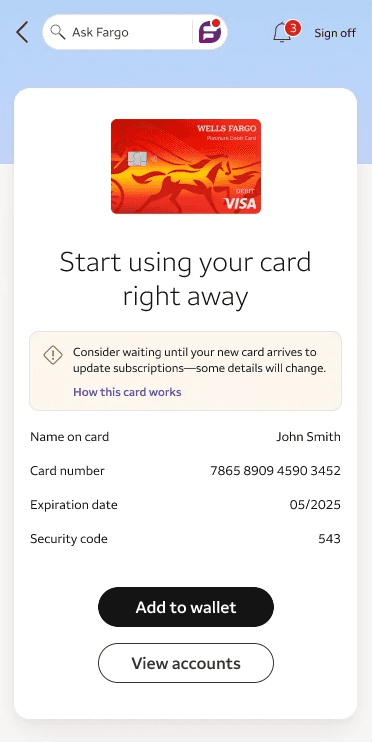
The digital card display needed language to identify the card and its credentials, but overqualifying it as "your digital card" or "your temporary card" would feel clunky and create a barrier to the future permanent state. Early iterations used "virtual card" — accurate, but it framed the feature as something separate from the real thing.
I changed the language to "your card" — no unnecessary modifiers. The temporary elements (CVV, expiration) were framed specifically rather than labeling the entire experience as temporary. This builds trust in the feature now and makes the content easily adaptable when the digital display becomes permanent — avoiding a full content rewrite down the road.
Customers who used their temporary CVV or expiration for recurring subscriptions would see those transactions decline after their physical card activated and the temporary credentials expired.
I introduced proactive guidance alerting users to update any subscriptions set up with temporary credentials once their physical card arrived. This prevents a frustrating downstream experience that could erode trust in the feature and generate support contacts.
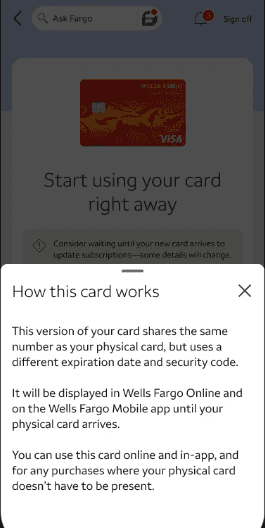
The card number was permanent (matching the physical card), but the CVV and expiration were temporary — a nuanced distinction that could easily confuse users. Legal and compliance required extensive disclosure around what was different, what was the same, where credentials were displayed, and for how long.
I designed a bottom sheet that covered everything legal required without cluttering the main card display. The card screen itself stays clean while the details on how it works are just a tap away.
The card display was accessible from multiple places — account summary, account details, card management, and card details. Rather than writing unique copy for each entry point, I created a single reusable message that worked across all four.
Customers now see their permanent card number alongside a temporary CVV and expiration date immediately for new and replacement cards, eliminating the need for rush shipping. Proactive guidance addresses the subscription update edge case and the transition to the physical card. A CTA encourages digital wallet enrollment — because once the physical card activates and the temporary credentials update, the digital wallet updates automatically, giving customers uninterrupted access.
The result is immediate card access at a moment that previously left customers waiting — turning a pain point into a seamless bridge between card issuance and delivery. The content framework established here is designed to scale toward a permanent digital card display experience.


The temporary credential distinction was the core content challenge. Labeling the whole card as "temporary" would undermine trust, but users needed to understand which parts would change. Scoping "temporary" to specific credentials solved this.
Surfacing the subscription edge case was a contribution that came from thinking beyond the happy path — content design caught a downstream scenario that wasn't in the original scope.
Writing for future-state scalability required restraint. It was tempting to expand on the temporary nature of the feature, but cleaner language made the content more durable.
If I could revisit this, I'd validate the subscription update messaging with usability testing to ensure it's reaching users at the right moment, and explore how the experience evolves once the digital display becomes permanent.